Blog Summary
The brown recluse spider is small (roughly quarter-sized), uniformly tan or brown, and identified by four key traits: a violin-shaped mark on its cephalothorax, six eyes arranged in three pairs, fine hairs instead of spines on its legs, and no stripes or banding. Found throughout the central and southern U.S., brown recluse bites are rare but can be serious.
The brown recluse spider (Loxosceles reclusa) has quite a reputation. And for good reason. These spiders carry a necrotic venom that, in rare cases, can trigger severe or even life-threatening reactions in bite victims. Add in the fact that they're relatively common throughout the central and southern United States, and it's easy to understand why so many homeowners want to know more about them.
The good news? Brown recluse bites are rare. But rare doesn't mean impossible, and knowing how to identify one is the first step toward keeping your household protected. Here's what to look for.
Brown Recluse Size: How Big are Brown Recluse Spiders?
For a spider with such a big reputation, brown recluse spiders are relatively small. They can vary from ¼- ¾ inch with legs extended. On average, they are about the size of a quarter. If you find yourself cornered by a big scary looking spider, chances are it isn’t a brown recluse. You may be seeing a wolf spider or other species.
What Are the Identifying Features of a Brown Recluse Spider?
1. Uniform Coloration
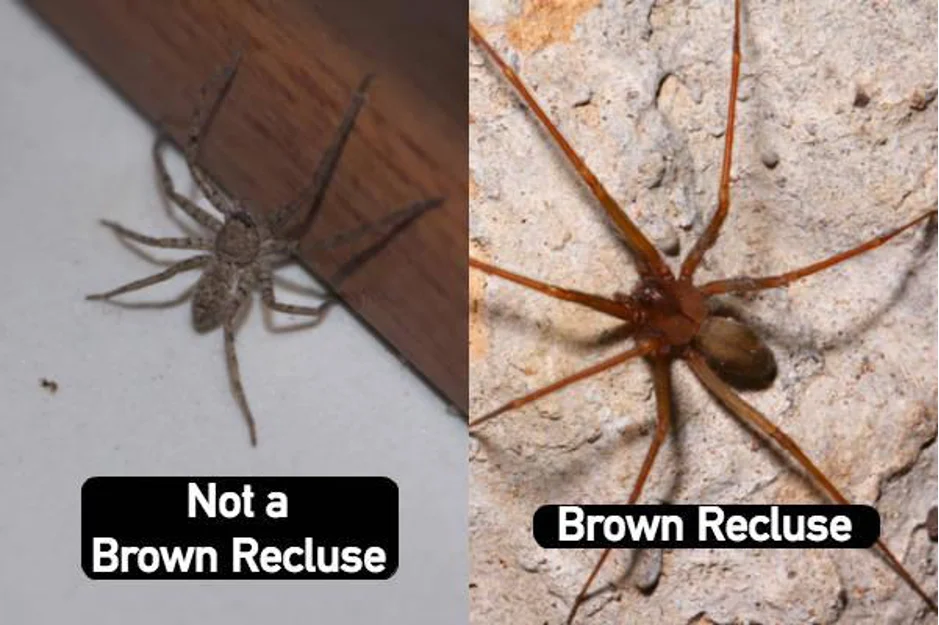
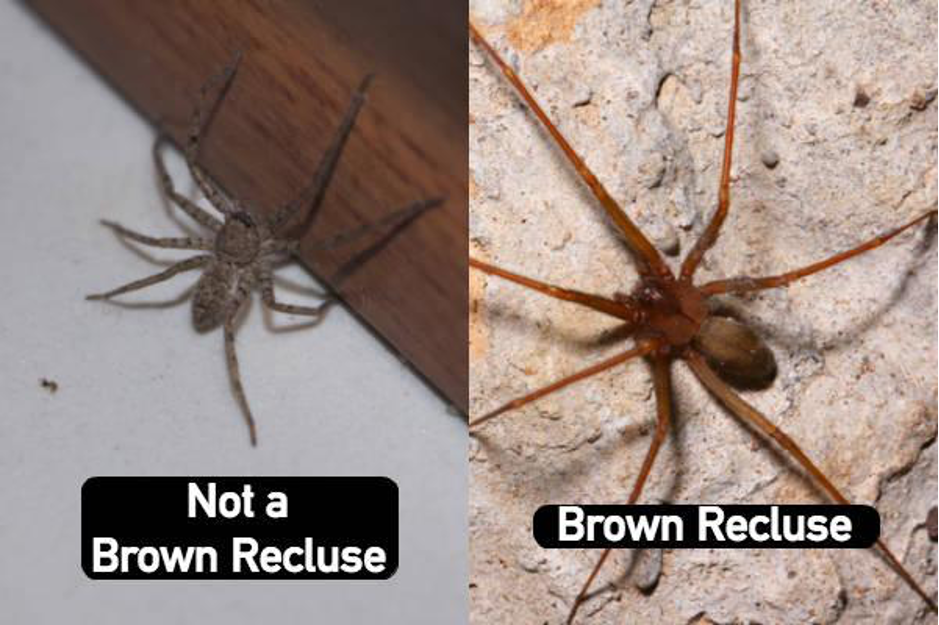
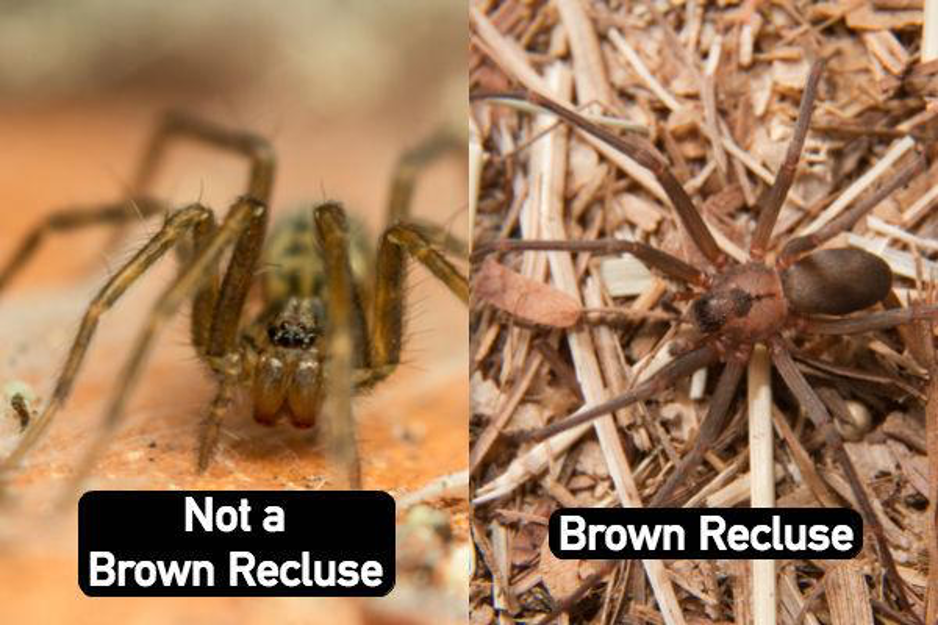
Brown recluse spiders range in color from light tan to a deeper, dirt-like brown. While the legs and head may vary slightly in shade, the overall coloration is largely consistent from head to leg, what you'd call mono-colored.
The one exception is a small, dark marking on the cephalothorax (which we'll cover in the section below).
What a brown recluse will never have is stripes, bands, or mottled patterning. If the spider you're looking at has any of those features, it's not a brown recluse. Many common spiders have multi-colored banding or speckled pigmentation on their legs, but brown recluses don't. And while it's common for a spider's legs to appear darker than its body, the opposite is true for the brown recluse: the legs tend to be lighter than the body.
2. “Violin” Mark
Every brown recluse has a single violin-shaped mark on the top of its cephalothorax (the fused head and thorax). This mark is always darker than the rest of the spider's body. The broad "body" of the violin sits just behind the eyes, and the mark tapers into a narrow "neck" as it extends toward the abdomen.
That said, the marking isn't always picture-perfect. It can vary in size, intensity, and shape from spider to spider, and on younger brown recluses, it may not be fully developed yet.
A few things to keep in mind when using this marking for identification: if the mark is lighter than the spider's body, it's not a brown recluse. And if the markings appear on the abdomen rather than the cephalothorax, you can rule out a brown recluse entirely.
3. Eye Pattern
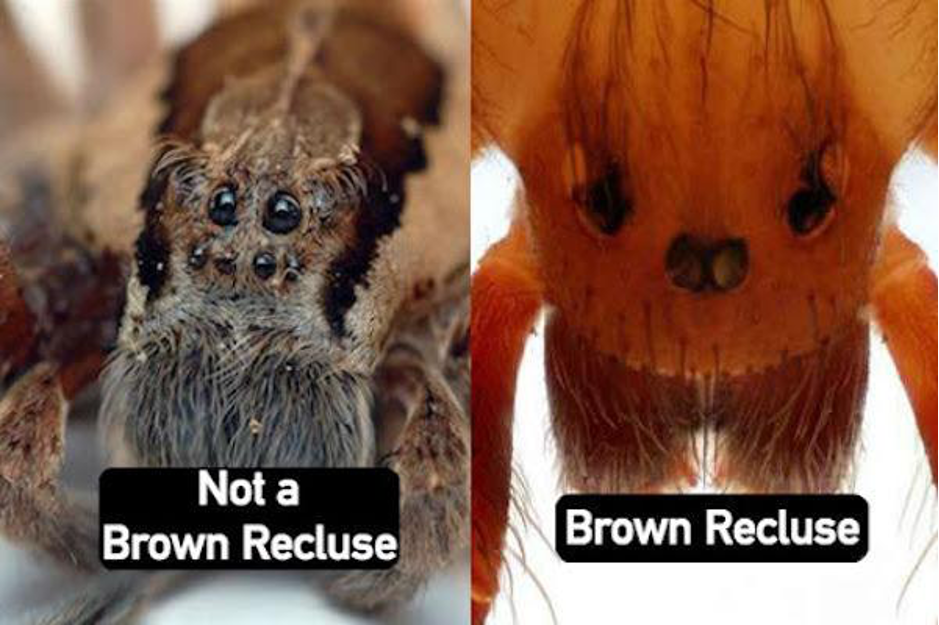
Most spiders have eight eyes, but the brown recluse only has six. They are arranged in three pairs: one pair in the center sitting slightly lower, and two pairs on the sides of the head sitting slightly higher.
The eyes themselves are very small and black, which makes them difficult to spot without a close look. It's worth noting that other spider species can share this same eye arrangement, so the eye pattern alone isn't enough to confirm a brown recluse. Use it alongside the violin mark and uniform coloration for a more confident identification.
A word of caution: we don't recommend getting too close to any spider you suspect might be a brown recluse. If you're concerned, try to trap it rather than handle it, or examine it once it's no longer living. You can also bring it to a doctor or pest professional for a positive ID.
4. Fine Hairs (Not Spines)
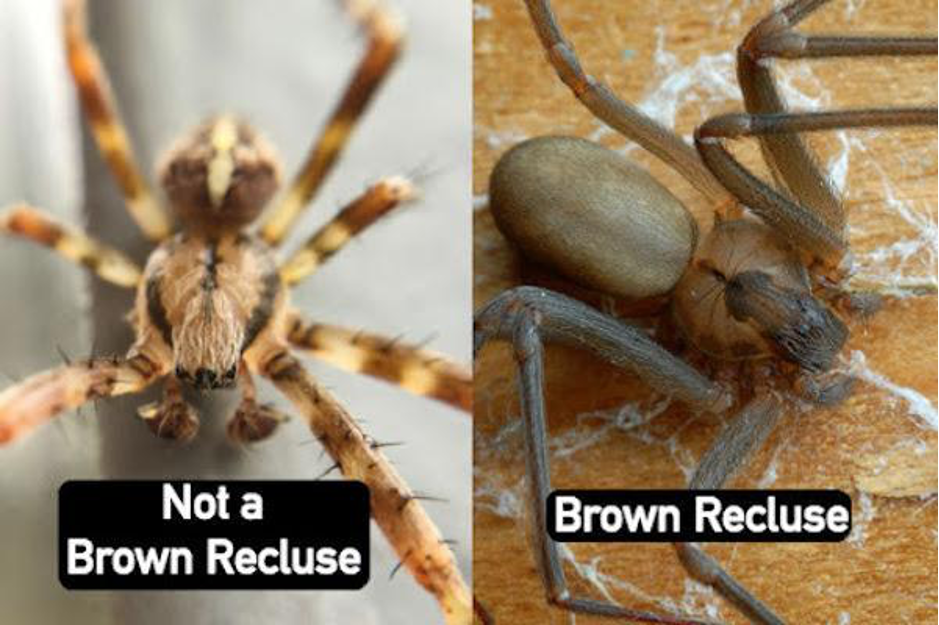
Most spiders, including common house spiders, have large spine-like structures on their legs and abdomens. These spines are actually thick, modified hairs that help the spider grip and hold its prey.
Brown recluses are different. Rather than spines, their legs and body are covered in short, fine hairs that are uniform in length and difficult to see with the naked eye. Like their coloration, this hair is consistent throughout the body.
If you look closely, you should be able to spot fine hair covering the spider everywhere except the head. Long, matted, or spine-like hair is a clear sign you're looking at a different species entirely. Brown recluse hair is not designed to ensnare prey the way spines are on other spiders.
Summing It All Up: What You Need to Know About Brown Recluse Spiders
The brown recluse spider:
- Small (¼ to ¾ inches).
- Uniformly tan or brown.
- Single brown violin mark near its head.
- Six eyes, not eight.
- Covered in fine hair without spines.
If the spider in your home has these characteristics, it might be a brown recluse. If it’s missing any, then it’s not.